Sunday, December 27, 2020

Inkpaduta #2) Wahpekute Dakota Youth and Early Manhood

 Wahpekute Dakota

The Wahpekute are one of the 4 Branches of the Dakota, or Eastern Sioux. Another term for the Dakota is "Santee Sioux."

The Wahpekute were closely associated with the Mdewakantons, another branch of the Dakota Sioux. The other branches of the Dakota are the Wahpeton and the Sisseton.

By the time of Inkpaduta's birth, the Ojibwe had pushed the Sioux out of the northern Minnesota lake and wild rice country onto the more open areas in southern and southwestern Minnesota.

Broadly speaking, in settlement times, the Mdewakanton were found in the lower Minnesota River valley and around the present-day Twin Cities with the Wahpekute generally located south of the Mdewakanton. The Sisseton and Wahpeton were located in the upper Minnesota River valley and out onto the (present day) Dakota plains.

The map below of the Sioux ranges is from a little before Inkpaduta's birth when portions of the Dakota were still in Minnesota lake country. Note the Wahpekute are in south-central Minnesota around the Minnesota River.


Later, the Mdewakanton and the Wahpekute played the major role in the 1862 Dakota War in Minnesota with minor help from the Sisseton and Wahpeton.

As with many aspects of Inkpaduta's life, there is controversy over the year of Inkpaduta's birth. Various historians date his birth to either 1800 or 1815, with 1815 being the more probable date. 

His father, Wamdisapa, was a war chief of a Wahpekute village led by Shakeska. His mother was either a Wahpekute or a Sisseton woman.

In his youth, he would have been taught to be a warrior and a hunter and enjoyed a life with outdoor games and sham battles.

By all accounts, Inkpaduta was not a handsome man. Somewhere along the way, he contracted smallpox as descriptions of him indicate that his face was pocked with smallpox scars. He was also described as "Squinty" due to his increasing nearsightedness.

The Sac and Fox Wars

In addition to increasing white settlement, a major feature of Inkpaduta's younger life and early manhood was war with the Sac and Fox tribes over hunting grounds in northern Iowa. 

Inkpaduta earned his reputation as a successful and noted warrior during the wars with the Sac and Fox.

Below is a George Catlin painting of a battle between the Sioux and the Sac (Sauk) and Fox.


However, the Sac and Fox wars are an early example of the controversies that marked Inkpaduta's Life.


The Mark of Cain

The frontier reputation of Inkpaduta as an evil renegade starts even before his birth. The Wahpekute were viewed by white settlers as a collection of renegades and outlaws from other bands. However, this reputation is likely due to their attacks on Mississippi River boats.

Surprisingly, as late as 1998, Michael Clodfelter in The Dakota War: The United States Army Versus the Sioux, 1862-1865 branded Inkpaduta with the Mark of Cain. He writes "The source of Inkpaduta's hatred and hostility toward the fair-haired, fair-eyed interlopers rests more in his genes than in his experiences."

Clodfelter adds "What drove and sustained Inkpaduta's wrath and rage, if it is to be explained at all, was an inheritance of character, not a chain of cause and effect."

An example of how schizophrenically the historical record has treated Inkpaduta is found on the very same page in Clodfelter as the above reference to the hatred found in his genes. Clodfelter writes "Ironically, Inkpaduta's relationship with the new race on the Minnesota frontier was often better than that with his kinsmen.....he even established a close friendship with Curtis Lamb."


Sunday, December 20, 2020

Inkpaduta #1--The Nearsighted Renegade Who Never Surrendered

The Nearsighted Renegade Who Never Surrendered

Inkpaduta (Scarlet Point) was a Wahpekute Dakota. An eastern Sioux chief who earned a bloody reputation as the leader of the Spirit Lake Massacre in northwest Iowa in 1857. Inkpaduta was reportedly very near-sighted and his face was pocked with smallpox scars.

The Spirit Lake Massacre was the culminating episode of a series of provocative events against the Indians. Over 3 dozen settlers were killed at Spirit Lake and associated events in southern Minnesota.

Four female captives were also taken by Inkpaduta's band with 2 of these women being killed during captivity and the other 2 survived. One wrote a well-known narrative of her captivity.

Inkpaduta's life encompassed the entire frontier history of the Sioux Nation in ways that no other leader's life did.

From pre-settlement life in Minnesota with wars against the Sac and Fox Indians to refuge on the Dakota Plains and large battles against the US Army in 1863 and 1864 to the Little Bighorn and finally refuge and a natural death in Canada; he was there for it all.

He is even mentioned as a great man of the Santees and Yanktonais who was present at the Little Bighorn by Black Elk in the famous work Black Elk Speaks.

He interacted with all the main Sioux leaders from Little Crow in Minnesota to Crazy Horse and Sitting Bull on the buffalo ranges. He was welcomed in many Sioux bands because of kinship ties and/or recognition of his status as a warrior and leader.

As much as his real deeds and and misdeeds and historical persona, a fascinating part of Inkpaduta's story is his reputation and how he was viewed by White settlers on the Frontier.

He is not very well-known today, but at the time of the Indian Wars, he was viewed by White settlers, and the first generations that followed, as the epitome of evil and considered the quintessential renegade.

Every Indian attack on the Northwest Frontier was assigned to Inkpaduta and he was said to be raiding from Canada to Kansas. Other Sioux used him as a scapegoat to escape blame for their own attacks.

The headline in the image below shows how Inkpaduta was still viewed many years after the events at Spirit Lake.

It is hard to read more than the headline, but it seems to be heralding the publication of a history of the Sioux by South Dakota State Historian Doane Robinson. The "Abaddon" of the headline refers to Inkpaduta and means "Destruction" or "Destroyer." He is a demon who works under Satan. 

It is striking that the editors of the newspaper expected their readership to know the definition of "Abaddon." The same assumption could not be made today.


It has to be recognized that after 1857, Inkpaduta had very little direct contact with whites and therefore, primary sources on his life, other than Indian accounts, are very scarce. 

Because the first generations of historians painted such a denigrating portrait of him and his association with the Spirit Lake Massacre, his reputation as an evil renegade persisted into recent times much more so than is the case for most other Indian leaders.

However, modern accounts tend to take a more balanced view of Inkpaduta and recognize that he is a hero to the Dakota.

Note on sources: Too numerous to mention. I have many "Sioux" books open to pages on Inkpaduta scattered on my dining room table, but the core source for this series on Inkpaduta is a 2008 book by Paul Beck "Inkpaduta: Dakota Leader."

Thursday, December 17, 2020

The 5* Main Sioux Wars

 The core information for this series of posts is taken from an article in the June 2020 issue of Wild West magazine. The article is titled "Worst of the Sioux Wars." 

I quibble with how they break things up here and will get into that as this series develops. I will also add other information.

1) The Oregon Trail War

A well-known mid 1850's episode among western history buffs. Took place in the mid 1850's and involved a famous episode of a Mormon's supposedly stolen cow at Fort Laramie. A small army command under Lieutenant Grattan was wiped out and Lakota Chief Conquering Bear was killed.

The major fight of this conflict was the Battle of Ash Hollow in November, 1855. Colonel William Harney and 600 soldiers wiped out a Brule village.

Harney became known as "Woman Killer" by the Sioux after Ash Hollow.

I like to think of this war as the "Oregon Trail War" as pertains to the story of the Sioux. The Sioux called the Oregon Trail, the Holy Road.

Crazy Horse was present for many of the events of this conflict as young teenager when he still went by the name of "Curly."

The thought strikes me that the Brule band of Lakota often get short shrift from western history buffs, because most of them went to the reservation early; but this was largely a Brule/Oglala episode in Sioux history.

Below: Fort Laramie and adjacent Indian Village as what the scene of the stolen cow may have looked at the time..


2A) The Minnesota War of 1862

As with the other posts in this series, the core idea for this outline was taken from the June 2020 issue of Wild West magazine.

The Minnesota War of 1862 was short spasm of extreme violence in the summer and fall of 1862. Starving Dakota Sioux rebelled and killed hundreds of settlers and soldiers.

This war is also notable for the Indian attacks on fixed positions at Fort Ridgely, New Ulm, Fort Abercrombie and pitched battles at Birch Coulee and Wood Lake

This war is one that I hope to look at in several posts in the future of this blog. I have touched on it, but to fulfill the mission of The Smoke of the Sioux I have to do a deep dive on it.

The Fort Abercrombie portion of this conflict might be the most interesting to look at as most histories of the war don't say much about it.

I have shown this picture before but it highlights my personal connection to the 1862 Dakota War in Minnesota. It is a picture of the timbers of a still standing building on the homestead of one branch of my family. My ancestors escaped, but the Sioux attempted to burn the building. However, the wood was too green.

Photo by author.


2B) The War of the Columns

The Wild West article counts this conflict as part of the Dakota War in Minnesota. However, while it is an offshoot of that conflict, I consider it a separate war and I call it "The War of the Columns." This war is almost unknown, even among hard-core history buffs as it was drowned out by the Civil War. I call it "The War of the Columns."

In the aftermath of the Minnesota 1862 War (The Dakota War); Army columns were sent out onto the Dakota plains in 1863 and 1864, and to a lesser extent in 1865; to punish those Indians responsible for the violence and who had escaped to the western plains.

I consider "The War of the Columns" to be separate from the Minnesota War because all three branches of the Sioux became entangled in it. The Dakota, Nakota and Lakota all played a role.

It is notable that some of the engagements in the War of the Columns may have had the largest number of combatants of any battle in the Indian Wars.

The 1863 fighting took place east of the Missouri River, in what is now North Dakota and the 1864 fighting happened west of the Missouri River, also in present-day North Dakota.

In an early post on this blog, I said that I consider North Dakota to be the central focus of Sioux history in the frontier era. The War of the Columns, in addition to the post immediately prior to this on the Sioux struggle against Fort Buford in North Dakota illustrates my point.

Of all the Sioux conflicts, I consider this to be my "favorite" possibly because it flies under the radar of western history.

"Columns of Vengeance" is a recent book about this episode in frontier history.

The photo below was taken at Killdeer Mountain which was the site an 1864 battle. Photo by author.


2C) The Sand Creek War

The Wild West article kind of shoehorns The Sand Creek War into this space. Most western history buffs are familiar with the Sand Creek Massacre where chivington and his Colorado Volunteers attacked a peaceful village of Southern Cheyenne and Arapaho under Chief Black Kettle.

After this attack, the central Plains erupted in a mass Indian War that united the Sioux, Cheyenne, Arapaho and Comanche. 

3) Red Cloud's War

The previous post on this blog includes a discussion of Red Cloud's War and the parallel struggle of the Northern Sioux against Fort Buford. At this point, I do not have much to add on this well-known conflict.

https://thesmokeofthesioux.blogspot.com/2020/12/no-not-that-late-1860s-sioux-war-on-us.html

Crazy Horse gained fame in this war by acting as a decoy in the Fetterman Massacre.

The picture below shows a portion of the Fetterman Massacre site. Photo by author.


4) The Great Sioux War of 1876-1877

Once again, at this point I have little to add to this well-known conflict at this point, except to note that when you study the Sioux all roads lead to the Little Bighorn.

View from Custer Hill toward the River. Photo by author.


5) The Ghost Dance and Wounded Knee

Heart-breaking episodes at the end of the Indian Wars.

Photo of the frozen body of Chief Big Foot at Wounded Knee


Monday, December 14, 2020

No!! Not That Late 1860's Sioux War on US Army Forts. I Mean the Other One.

 Anybody with even a cursory interest in western history is likely aware of Red Cloud's War against US Army forts along the Bozeman Trail in the Powder River Country of Wyoming in the late 1860's. Famous names like Red Cloud, Crazy Horse and Fetterman and events like the Fetterman Massacre and the Hayfield and Wagon Box fights are deservedly well-known to western history buffs.

Running concurrently with the better-known Red Cloud's War, the northern Lakota and their allies fought a war against Missouri River traffic and the new forts along the Missouri River in North Dakota. These fights are much less well-known. However, the northern Sioux hated these forts as much, or more, than the southern Sioux hated the Bozeman Trail forts.

It is worth noting that there are countless books and articles dealing with Red Cloud's War in the Powder River country, but the parallel war against the Missouri River forts and river traffic barely warrants a few pages in most books on the Sioux and even is barely mentioned in biographies of participants such as Sitting Bull and Gall. 

Fort Buford, built in the summer of 1866, at the junction of the Yellowstone and Missouri Rivers in extreme northwest North Dakota especially aroused the ire of the Sioux. Fort Stevenson was another new fort located 150 miles downstream from Fort Buford that was not popular with the Sioux. However, Fort Stevenson was not as hated as Fort Buford and one source said the Sioux went to Fort Stevenson for trade and Fort Buford for scalps. Having said that, they certainly still raided in the vicinity of Fort Stevenson.

Note the locations of Forts Buford and Stevenson in the upper left quadrant of the North Dakota map below.


Fort Buford was the site where Sitting Bull and his band surrendered in 1881 after their four year refuge in Canada. That is a well-known fact among western history readers. Less well-known is his hatred for the fort in the first place and the attacks that took place on the fort.

It is worth noting that Fort Abraham Lincoln (in the center of the map) was the jumping off point for Custer's expedition to the Black Hills in 1874 and for his fateful trip to the Little Bighorn in 1876.

General Winfield Scott Hancock visited the river posts in the summer of 1868 and singled out Fort Buford as a post exceedingly offensive to the Sioux and made the comment that it had been under almost constant siege since its founding.

Given that the scope of this blog includes all branches of the Sioux, I was especially interested to note from a book called Forts of the Upper Missouri that the Santee (Dakota) branch of the Sioux were involved in this campaign along with the better known Hunkpapa Lakota. The Santee, or eastern Sioux had been forced to this region after being pushed west by white settlement farther east.

Forts of the Upper Missouri notes that the Santee hated Fort Buford with a passion and never lost a chance to raid the neighborhood. They ranged north of the fort and escaped across the  Canadian border when necessary. Lieutenant Colonel Henry Morrow who took command of the fort in the Spring of 1869 said "They (the Santee) are the terror of the left (north) bank of the Missouri River."

It stands to reason that many of these Santee warriors were veterans of the 1862 war in Minnesota and the War of the Columns in 1863 and 1864.

It is striking that the Fetterman Massacre of Red Cloud's War occurred on December 21, 1866, at exactly the same time that Sitting Bull was in the middle of 4 days of major raids on Fort Buford that started on December 20. On the morning of the 4th day, Lakota warriors even took over the fort's icehouse and sawmill and had to be dislodged with cannon fire.

Note the sawmill and icehouse at the south-central boundary of Fort Buford shown on the fort plan below.


There was only one company of infantry of about 100 men stationed at Fort Buford that first winter and there were repeated rumors downstream that the garrison had been wiped out. Four more companies were sent to the fort in the spring.

However, as usual in Indian warfare, attacks on fortified posts were rare and the usual mode of operation was to attack isolated parties and travelers. 

Attacks on river boats,while common, usually consisted of sniping and barrages of fire from the bank. It does not appear that there were a lot of casualties on the boats, especially as they became more heavily fortified to deal with the attacks.

I can't find the source right now, but I remember being struck by past reading that Chief Gall of the Hunkpapa had killed at least 7 whites in these attacks on the river forts and traffic. When you consider that 80 soldiers died in the well-known Fetterman Massacre and here we have just one warrior killing almost ten percent of that amount in an almost unknown conflict; it doesn't seem fair somehow that this (Sitting Bull's?) northern war is not more well-known.

The violence around Fort Buford seems to have been winding down by 1870 except for raids on isolated parties and so forth.

Lakota America, a 2019 book on Lakota history, notes that in the Fall of 1870; Sitting Bull conducted a large cattle-butchering raid against Fort Buford. After this, he moved away from the area to the Montana and Wyoming buffalo ranges.

Sitting Bull's war on the Missouri River forts was not as successful as Red Cloud's war at the same time was, but it certainly deserves more recognition than it usually receives. Hey, it even had a "Hayfield Battle" like Red Cloud's War did.


Geographic Location of the Lakota Bands

 I am interested in the core homelands of the Lakota bands in historic times. I realize that the bands roamed all over and intermixed in other areas, but there are core locations that each band is identified with in historic times.

Paul Hedren's book After Custer identifies the discrete subsections of Sioux country occupied by each Lakota band from the 1850's onward.

1)The Two Kettles occupied the middle Missouri region in western South Dakota.

2) The Hunkpapa and Blackfeet Sioux lived farther north in western North Dakota and eastern Montana. Hedren notes throughout the book that the Hunkpapa were associated with the game-rich Little Missouri badlands in western North Dakota and the "Big Open" in the triangle of land between the Yellowstone, Missouri and Musselshell Rivers.

3) The Miniconjou are associated with the areas north and east of the Black Hills while the Sans Arc lived west and southwest of the Black Hills

4) The Oglala's homeland was the North Platte basin in Wyoming and Nebraska.

5) The Brule occupied the White River and Pine Ridge country of northern Nebraska and southern South Dakota.

6) I personally consider the Yanktonai Sioux to be honorary Lakota and they are commonly associated with the areas east of the Missouri River in northern South Dakota and southern North Dakota. As white expansion pushed them west they tended to associated with the Hunkpapa and areas along the Missouri River in eastern Montana.

Hedren notes that the Sioux continually expanded their lands westward and northward. This expansion is also a major theme in a recent book Lakota America.


Friday, February 15, 2019

The Surprising Tie to "The Last of the Mohicans"

In my previous 3 posts I mentioned that I was intrigued by the Sioux war with the Sauk tribe, mainly in Iowa. However, in my readings for this blog, nothing has surprised me as much as the Sioux war with the Huron tribe in the mid-1600's.

In colonial American literature, the Huron tribe are usually the bad guys. This is most notable in "The Last of the Mohicans." The picture below is of  Magua, the Huron villain, in the most recent version of the film.

"The Last of the Mohicans" is set in the French and Indian War in the late 1750's.

In a climactic scene, Magua leaves the Huron village to go west and join the the "Huron of the Lakes."

I was surprised to find a Sioux tie to the Huron. In the middle of the 1600's, about 100 years before the events portrayed in "The Last of the Mohicans" a group of Hurons from the Georgian Bay area of Lake Huron fled west from Iroquois attacks.

These Huron sought refuge among the Dakota Sioux in the Mississippi River region. It is reported by a French trader , Perrot, that they brought iron tools with them and the Sioux, who had not yet seen iron, viewed them as having supernatural powers.

After living in peace for several years, the Huron desired more Sioux lands and went to war against them. The Sioux pushed them back into Wisconsin, towards Lake Superior.

Perrot reported that the Huron sent war parties to attack the Sioux in their villages which were located in areas with nothing but lakes and marshes. He said they made good use of the terrain and lured the Huron into favorable terrain for attacks (on the Huron.)

The picture below is of a wild rice marsh off a large lake and the bottom picture is of a wild rice marsh. These are likely the typical scenes of conflict between the Sioux and Huron.


 Perrot also noted that the Sioux were less cruel than the Huron until they saw how the Huron treated Sioux captives. Once again, the Huron appear to be the bad guys.

The outcome of this war appears to be that the Huron were pushed back east to the region of Mackinac Island.

Wednesday, February 13, 2019

War to the Knife with the Sauk #3

By David Wrolson

The Sauk (and Fox) war with the Sioux as seen through George Catlin's eyes.

He painted this image of a battle between the Sauk and the Sioux.


The following sentences are taken from his writings.

>>>When General Street and I arrived at Kee-okuks village, we were just in time to see this amusing scene, on the prairie a little back of the village. The Foxes (allies of the Sauk), who were making up a war-party to go against the Sioux, and had not suitable horses by twenty, had sent word to the Sacs, the day before (according to ancient custom), that they were coming on that day, at a certain hour, to "smoke" that number of horses.<<<

Wednesday, February 6, 2019

War to the Knife with the Sauk #2

By David Wrolson

Iowa as a "Dark and Bloody Ground".

I am intrigued by the Sioux war with the Sauk and Fox. I knew very little about it prior to this project.

The Sauk (and Fox) had been pushed west by white settlement into Iowa and this brought them into conflict with the Sioux.

It is interesting that I have run across indications that it was not just the eastern Sioux that were involved. I have run across indications that all 3 Sioux branches were involved. The Dakota, Nakota and the Lakota all were in a war to the knife with the Sauk.

The early reading I have done on this indicate that the 1820's were a violent time in this war with raids back and forth by both sides. This 1820's violence explains why the Sioux (as referenced in the previous post) were eager to help the whites in the Black Hawk War in 1832.

I was aware of the treaty line dividing the Sioux from the Chippewa in central Minnesota, however I did not know that similar line divided the Sioux from the Sauk in northeast Iowa.

Kentucky in the old days is often called a "Dark and Bloody Ground." Well, after following the smoke of the Sioux into the Sauk war, I can't help but also thinking of Iowa as a dark and bloody ground. The boundary line was not sufficient to keep the tribes apart. A 40-mile neutral zone was established along the line as a buffer to keep the tribes apart.

The buffer is shown as the 2 diagonal rectangles in northeast Iowa on the map below.


The smoke of the Sioux traveled widely and I wonder if they raided the Sauk in Illinois

War to the Knife with the Sauk #1

By David Wrolson

I mentioned in a previous post that in my readings on Fort Snelling one surprising thing that jumped out at me was the enmity between the Sioux and the Sauk(and Fox) tribes.

This warfare was at such a level that when the remnants of the Sauk and Fox fled west away from the whites across the Mississippi after the Black Hawk War the Sioux attacked them in their time of distress and killed many of them.

I found indications that the Sioux were patrolling the western shore of the Mississippi to prevent the Sauk from crossing the river and escaping the whites.

However, their warfare straddled both before and after the Black Hawk War of 1832 with the scene of the fighting apparently concentrated in Iowa.

Sauk Chief Black Hawk shown below:

Disappointing Visit to Fort Snelling

By David Wrolson

We made a June 2018 visit to Fort Snelling at the junction of the Minnesota and Mississippi Rivers. Fort Snelling was crucial to the history of the Dakota (eastern Sioux).

The reason it was somewhat disappointing is because everything is now covered by trees. The fort itself was interesting and I will talk more about Snelling in future posts.

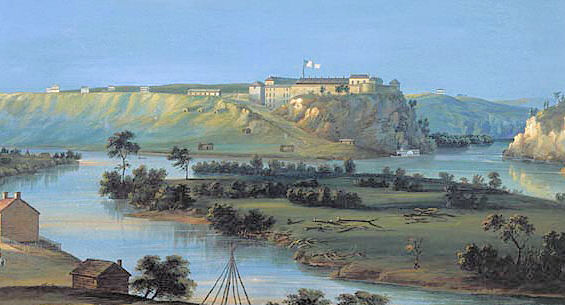
Below is a picture of Fort Snelling in the old days. As you can see, the fort is a commanding presence high on the bluffs.

Below are some pictures taken from the fort down towards the river.


While the pictures don't do it justice, trees are everywhere now. It was hard to get a taste of Fort Snelling as a commanding presence above the rivers. We also walked down to the river and, once again, trees were everywhere and you could not really see the fort.

Monday, December 3, 2018

The Eagle Bone Whistles of the Sioux

By David Wrolson:

I ran across an evocative phrase in a song. "Custer's Ghost" sung by Dave Stamey.

https://www.youtube.com/watch?v=17DYcEy9mmY

If the link does not work, just type "Dave Stamey Custer's Ghost" into Youtube.

Libby's Gone
Like the Buffalo
Like the Eagle Bone Whistles of the Sioux

I remember running across information that the Sioux blew eagle bone whistles in battle.

When I listen to that song and especially that phrase, I can hear the piercing whistles above the noise and dust of the Little Bighorn.

Below is a picture of an eagle bone whistle.


Saturday, June 9, 2018

The Iowa Front-The Sauk (and Fox) and the Sioux

By David Wrolson

Contrary to previous posted plans, I have not been wandering the frontiers of New France looking at first contact with the Sioux.

Instead, I have been reading up on Fort Snelling in preparation for an upcoming research visit/family trip to the Fort. I have not been there since 1975, when I was 8 years old.

The main book I am reading on Fort Snelling is a 1966 book called "Citadel in the Wilderness:The Story of Fort Snelling and the Northwest Frontier." I am also looking at a couple of smaller. more recent books.

Fort Snelling is central to Dakota (Eastern Sioux) history in the early 1800's and will appear in various future posts. However, one interesting thing that jumps out at me on first blush is the "War to the Knife" between the Sioux and the Sauk.

Tuesday, April 3, 2018

Off to the Frontiers of New France for awhile

By David Wrolson

My plan for the next while going forward is to dig into the early French contacts with the Sioux and related areas. I need to do some research into this area to see how everything fits together as I don't know enough about it.

Don't expect a lot of posts for the next while as spring field work starts soon and I need to learn a lot more about the French era.

I can't do much do much for awhile anyway on things like the Dakota Uprising/Fort Snelling and the campaigns in the Dakotas and points west as I would like to visit those sites for context and pictures and those sites don't really open up till Mid-May or later.

I really think "The Smoke of the Sioux" will be better over time if I get a good handle on the French era first. So off I go, into 17th and 18th Century New France and the frontiers beyond it for awhile.

I have had Francis Parkman's History of New France on my list for awhile and, surprisingly, the index has a large number of entries for "Sioux", so Parkman beckons.


Sunday, April 1, 2018

Louis L'amour's Great-Grandfather Killed at the Battle of Big Mound

I was wrong in the previous post when I said I thought that Louis L'amour's Great-Grandfather was killed at the Battle of Whitestone Hill. It turns out that he was killed in a skirmish surrounding the Battle of Big Mound instead.

It is widely reported that during the opening sequences of the Battle of Big Mound that Lieutenent Ambrose Freeman (L'amour's Great-Grandfather) and George Brackett, a civilian contractor, were off hunting antelope and were joined by some friendly Dakota. Subsequently, they were attacked by a war party of other Sioux and Freeman was killed.

We will discuss the Battle of Big Mound in future posts, but this appears to be one of those battles in the1863 campaign that involved the Dakota, Nakota and Lakota tangling with the soldiers.

Interestingly, this battle took place well east of the Missouri River and Sitting Bull is often placed as being at the Battle of Big Mound and other battles in this area.

It is somewhat odd to think of Sitting Bull fighting US soldiers well east of the Missouri River in 1863. These battles are obviously overshadowed by events at places like Gettysburg, Vicksburg and Chickamauga.

Monday, March 26, 2018

North Dakota as the "Old West" Heart of Sioux History

One of the paths I plan to explore in "The Smoke of the Sioux" is North Dakota as the "Old West" heart of Sioux history.

Large US Army columns were sent west into present-day North Dakota in 1863 and 1864 to punish the Sioux for the 1862 Dakota Uprising in Minnesota. These army columns tangled with all 3 branches of the Sioux nation. The Dakota, Nakota, and Lakota were all involved in this very confused fighting.

Sitting Bull and his Hunkpapa carried out a long war against Fort Buford which is located near the confluence of the Yellowstone and Missouri Rivers in northwest North Dakota. Sitting Bull hated Fort Buford. Ironically, Fort Buford was the site of his surrender in 1881.

The struggles between the Metis, with their screeching Red River carts that could be heard for miles, and the Sioux was largely a North Dakota thing. The April 2018 issue of Wild West magazine mentions the 1848 Battle of O' Brien's Coulee (in North Dakota) "that pitted roughly 800 Metis and 200 Chippewa against 1,000 Sioux."

The Indians called the US/Canada border the "Medicine Line." I have a book called "The Arc of the Medicine Line" about the surveying of this line. I have yet to read this book, but the relationship between the Sioux and the surveying of the Medicine Line would have been, in large part, a North Dakota affair.

Cursory research into Lewis and Clarks' contacts with the Sioux indicate that the Sioux raided the Mandan with whom Lewis and Clark spent the first winter of their trek in central North Dakota. I plan to delve into the Lewis and Clark contacts with the Sioux sooner rather than later.

It is hard to find quick information on this,  but Louis L'amour's great-grandfather was killed by the Sioux and, contrary to most reports which list him as a settler, I think he was a soldier killed in 1863 at Whitestone Hill in North Dakota. Whitestone Hill was one of those tangled 1863/1864 battles referenced above.


To "Wild West Magazine" Re: Lakota-Schmakota

I have never subscribed to any of the "Wild West"/"True West" Magazines, but for the purposes of "The Smoke of the Sioux" I chose to pick up my first copies from the newstand and then subscribed with the enclosed subscription cards.

I was a little surprised to see the following sentences appear in the April 28, 2018 issue of Wild West:The American Frontier in a story titled "Conquering Bear's Short Reign."

The Lakotas passed the pipe and debated among themselves for long awkward minutes about this strange concept. At last a Yankton Chief stood, came forward and placed his stick in Conquering Bear's hand. One by one the others followed until he held all 24 sticks. Americans observing th eproceedings believed a Lakota "Senate" had just appointed a "president." The Lakotas believed they had designated Conquering Bear their temporary spokesman.

I was a little surprised on my first reading of this magazine to see the apparent inclusion of the Yankton into the Lakota grouping. It would be easy for someone upon reading this to assume that the Yankton are Lakota, rather than Nakota, and this can cause years of confusion for the reader.

The first post of "The Smoke of the Sioux" outlined the 7 Council Fires of the Great Sioux Nation and it is interesting that the Yankton , which are one of 2 branches of the Nakota, are considered to be at the same hierarchical level as the much more famous Lakota.

The Yanktonnais are the other branch of the Nakota and are also at the same hierarchical level as the Lakota.

Tuesday, March 20, 2018

The Hard Way to the Little Bighorn

The first post in "The Smoke of the Sioux" outlined as best I can the structure of the Sioux Empire.

https://thesmokeofthesioux.blogspot.com/2018/03/the-7-council-fires-of-great-sioux.html

One way to illustrate the unity of the Sioux Empire and honor the Eastern Sioux who were at the Little Bighorn after a tough 15 years is to point out their presence at the Little Bighorn.

Everybody knows about the Lakota and Cheyenne at Custer's Last Stand, but few know of the Dakota and Nakota presence there.

Doane Robinson in "A History of the Dakota or Sioux Indians" says:

"and seventh, the Santees and the Yanktonais, being the remnant of the unsubdued hostiles from the War of the Outbreak in Minnesota, under Inkpaduta."

Santee is another name for the Eastern Sioux, or Dakota. Inkpaduta ties things way back to the 1857 Spirit Lake Massacre in Iowa.

There weren't many Santee and Yanktonais there, they had come a hard way to get there, but they were there, riding with their Lakota cousins.

The best information I have seen places the Santee and Yanktonais as camping on the south end of the Indian camp with the Hunkpapa. This was the area Reno attacked in the early stages of the battle.

We will come back to the Little Bighorn later, but it seemed fitting to tie the Dakota and Nakota to the Lakota at their last great moment as free warriors.

The Buffalo Ridge and Books

I found these pictures from 2008 while going through old pictures and I could not resist posting. The first set are from a rancher who also had a Western book store on his ranch located in the lee of the Buffalo Ridge. We will come back to the Buffalo Ridge again, but for now, enjoy these pictures from the Sisseton-Wahpeton Reservation.


I also could not resist posting these pictures from an appraisal from 10 years ago, to my knowledge the house has been torn down and there are no identifying features. I promise it is not my house LOL.


Monday, March 19, 2018

Some Treaty Lines and Maps

I found some interesting treaty maps online. This first one is most intriguing. Note that the Dakota Cession of 1837 included a big chunk of Wisconsin, along with Minnesota. In a way I am gobsmacked that, less than 40 years before the Battle of the Little Bighorn, the Sioux still had a large presence in Wisconsin. It is astounding how fast things can change

Lest one say the Wisconsin Sioux were Dakota and thus different from the Lakota of the Little Bighorn, we need to recognize that there were Eastern Sioux riding against Custer at the Little Bighorn and they got there the hard way.

I had not planned to do the Little Bighorn for awhile, but I think the next post might jump ahead to the Little Bighorn and take a quick look at the Eastern Sioux that were there and whose role is almost totally forgotten by history.


The second map shows the large 1851 Treaty of Traverse des Sioux Cession by the Dakota that included most of southern Minnesota, except for a 20-mile wide band along the western part of the Minnesota River. These reserved lands were very important during the 1862 Dakota Uprising.

Note the "Dakota-Ojibway Treaty Line of 1825" running through the center of the state. This was an attempt to stop the fighting between the tribes. We will be looking closer at this line later.


The First Existential War the Sioux Lost

We need to remember that the Sioux war with the Whites that took place from about 1850 to 1890 was the second existential war the Sioux lost in historic memory. The first was the one they lost when the Chippewa (Ojibway) kicked them out of their homeland in the Minnesota woods.

This war was part of the vast movement of tribes that took places beyond the edges of the white frontier as tribes jockeyed for position. The Chippewa had better access to firearms and so forth and this is likely one of the reasons they won the war.

The Sioux were first encountered in the far northern Minnesota woodlands by French traders and explorers in the 17th and 18th Centuries. The Sioux were a people of the Minnesota wild rice beds far longer than they were a people of the buffalo.

Various factions, such as the Tetons, moved out of the woodlands earlier with successive waves following. I suspect that they were pushed by the Ojibway and pulled by the buffalo. Then they displaced other tribes farther west.

The war with the Ojibway was a "War to the Knife" and took place over decades, maybe even centuries. The Sioux/Chippewa War will feature prominently in this blog. As will the tribes displaced by the Sioux farther west.

If I remember correctly, there were Sioux vs Ojibway skirmishes that were visible from the walls of Fort Snelling. Fort Snelling is located at the confluence of the Minnesota and Mississippi Rivers at the core of Twin Cities Metropolitan Area.

The following photo is taken from a Google image search and shows Fort Snelling as it was "Back in the Day."