By David Wrolson
Iowa as a "Dark and Bloody Ground".
I am intrigued by the Sioux war with the Sauk and Fox. I knew very little about it prior to this project.
The Sauk (and Fox) had been pushed west by white settlement into Iowa and this brought them into conflict with the Sioux.
It is interesting that I have run across indications that it was not just the eastern Sioux that were involved. I have run across indications that all 3 Sioux branches were involved. The Dakota, Nakota and the Lakota all were in a war to the knife with the Sauk.
The early reading I have done on this indicate that the 1820's were a violent time in this war with raids back and forth by both sides. This 1820's violence explains why the Sioux (as referenced in the previous post) were eager to help the whites in the Black Hawk War in 1832.
I was aware of the treaty line dividing the Sioux from the Chippewa in central Minnesota, however I did not know that similar line divided the Sioux from the Sauk in northeast Iowa.
Kentucky in the old days is often called a "Dark and Bloody Ground." Well, after following the smoke of the Sioux into the Sauk war, I can't help but also thinking of Iowa as a dark and bloody ground. The boundary line was not sufficient to keep the tribes apart. A 40-mile neutral zone was established along the line as a buffer to keep the tribes apart.
The buffer is shown as the 2 diagonal rectangles in northeast Iowa on the map below.
The smoke of the Sioux traveled widely and I wonder if they raided the Sauk in Illinois
Wednesday, February 6, 2019
War to the Knife with the Sauk #1
By David Wrolson
I mentioned in a previous post that in my readings on Fort Snelling one surprising thing that jumped out at me was the enmity between the Sioux and the Sauk(and Fox) tribes.
This warfare was at such a level that when the remnants of the Sauk and Fox fled west away from the whites across the Mississippi after the Black Hawk War the Sioux attacked them in their time of distress and killed many of them.
I found indications that the Sioux were patrolling the western shore of the Mississippi to prevent the Sauk from crossing the river and escaping the whites.
However, their warfare straddled both before and after the Black Hawk War of 1832 with the scene of the fighting apparently concentrated in Iowa.
Sauk Chief Black Hawk shown below:
I mentioned in a previous post that in my readings on Fort Snelling one surprising thing that jumped out at me was the enmity between the Sioux and the Sauk(and Fox) tribes.
This warfare was at such a level that when the remnants of the Sauk and Fox fled west away from the whites across the Mississippi after the Black Hawk War the Sioux attacked them in their time of distress and killed many of them.
I found indications that the Sioux were patrolling the western shore of the Mississippi to prevent the Sauk from crossing the river and escaping the whites.
However, their warfare straddled both before and after the Black Hawk War of 1832 with the scene of the fighting apparently concentrated in Iowa.
Sauk Chief Black Hawk shown below:
Disappointing Visit to Fort Snelling
By David Wrolson
We made a June 2018 visit to Fort Snelling at the junction of the Minnesota and Mississippi Rivers. Fort Snelling was crucial to the history of the Dakota (eastern Sioux).
The reason it was somewhat disappointing is because everything is now covered by trees. The fort itself was interesting and I will talk more about Snelling in future posts.
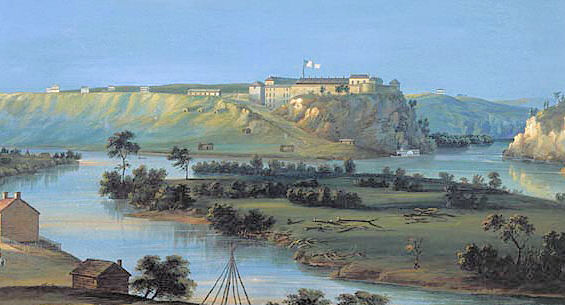
Below is a picture of Fort Snelling in the old days. As you can see, the fort is a commanding presence high on the bluffs.
Below are some pictures taken from the fort down towards the river.
While the pictures don't do it justice, trees are everywhere now. It was hard to get a taste of Fort Snelling as a commanding presence above the rivers. We also walked down to the river and, once again, trees were everywhere and you could not really see the fort.
We made a June 2018 visit to Fort Snelling at the junction of the Minnesota and Mississippi Rivers. Fort Snelling was crucial to the history of the Dakota (eastern Sioux).
The reason it was somewhat disappointing is because everything is now covered by trees. The fort itself was interesting and I will talk more about Snelling in future posts.
Below is a picture of Fort Snelling in the old days. As you can see, the fort is a commanding presence high on the bluffs.
Below are some pictures taken from the fort down towards the river.
While the pictures don't do it justice, trees are everywhere now. It was hard to get a taste of Fort Snelling as a commanding presence above the rivers. We also walked down to the river and, once again, trees were everywhere and you could not really see the fort.
Monday, December 3, 2018
The Eagle Bone Whistles of the Sioux
By David Wrolson:
I ran across an evocative phrase in a song. "Custer's Ghost" sung by Dave Stamey.
https://www.youtube.com/watch?v=17DYcEy9mmY
If the link does not work, just type "Dave Stamey Custer's Ghost" into Youtube.
Libby's Gone
Like the Buffalo
Like the Eagle Bone Whistles of the Sioux
I remember running across information that the Sioux blew eagle bone whistles in battle.
When I listen to that song and especially that phrase, I can hear the piercing whistles above the noise and dust of the Little Bighorn.
Below is a picture of an eagle bone whistle.
I ran across an evocative phrase in a song. "Custer's Ghost" sung by Dave Stamey.
https://www.youtube.com/watch?v=17DYcEy9mmY
If the link does not work, just type "Dave Stamey Custer's Ghost" into Youtube.
Libby's Gone
Like the Buffalo
Like the Eagle Bone Whistles of the Sioux
I remember running across information that the Sioux blew eagle bone whistles in battle.
When I listen to that song and especially that phrase, I can hear the piercing whistles above the noise and dust of the Little Bighorn.
Below is a picture of an eagle bone whistle.
Saturday, June 9, 2018
The Iowa Front-The Sauk (and Fox) and the Sioux
By David Wrolson
Contrary to previous posted plans, I have not been wandering the frontiers of New France looking at first contact with the Sioux.
Instead, I have been reading up on Fort Snelling in preparation for an upcoming research visit/family trip to the Fort. I have not been there since 1975, when I was 8 years old.
The main book I am reading on Fort Snelling is a 1966 book called "Citadel in the Wilderness:The Story of Fort Snelling and the Northwest Frontier." I am also looking at a couple of smaller. more recent books.
Fort Snelling is central to Dakota (Eastern Sioux) history in the early 1800's and will appear in various future posts. However, one interesting thing that jumps out at me on first blush is the "War to the Knife" between the Sioux and the Sauk.
Contrary to previous posted plans, I have not been wandering the frontiers of New France looking at first contact with the Sioux.
Instead, I have been reading up on Fort Snelling in preparation for an upcoming research visit/family trip to the Fort. I have not been there since 1975, when I was 8 years old.
The main book I am reading on Fort Snelling is a 1966 book called "Citadel in the Wilderness:The Story of Fort Snelling and the Northwest Frontier." I am also looking at a couple of smaller. more recent books.
Fort Snelling is central to Dakota (Eastern Sioux) history in the early 1800's and will appear in various future posts. However, one interesting thing that jumps out at me on first blush is the "War to the Knife" between the Sioux and the Sauk.
Tuesday, April 3, 2018
Off to the Frontiers of New France for awhile
By David Wrolson
My plan for the next while going forward is to dig into the early French contacts with the Sioux and related areas. I need to do some research into this area to see how everything fits together as I don't know enough about it.
Don't expect a lot of posts for the next while as spring field work starts soon and I need to learn a lot more about the French era.
I can't do much do much for awhile anyway on things like the Dakota Uprising/Fort Snelling and the campaigns in the Dakotas and points west as I would like to visit those sites for context and pictures and those sites don't really open up till Mid-May or later.
I really think "The Smoke of the Sioux" will be better over time if I get a good handle on the French era first. So off I go, into 17th and 18th Century New France and the frontiers beyond it for awhile.
I have had Francis Parkman's History of New France on my list for awhile and, surprisingly, the index has a large number of entries for "Sioux", so Parkman beckons.
My plan for the next while going forward is to dig into the early French contacts with the Sioux and related areas. I need to do some research into this area to see how everything fits together as I don't know enough about it.
Don't expect a lot of posts for the next while as spring field work starts soon and I need to learn a lot more about the French era.
I can't do much do much for awhile anyway on things like the Dakota Uprising/Fort Snelling and the campaigns in the Dakotas and points west as I would like to visit those sites for context and pictures and those sites don't really open up till Mid-May or later.
I really think "The Smoke of the Sioux" will be better over time if I get a good handle on the French era first. So off I go, into 17th and 18th Century New France and the frontiers beyond it for awhile.
I have had Francis Parkman's History of New France on my list for awhile and, surprisingly, the index has a large number of entries for "Sioux", so Parkman beckons.
Sunday, April 1, 2018
Louis L'amour's Great-Grandfather Killed at the Battle of Big Mound
I was wrong in the previous post when I said I thought that Louis L'amour's Great-Grandfather was killed at the Battle of Whitestone Hill. It turns out that he was killed in a skirmish surrounding the Battle of Big Mound instead.
It is widely reported that during the opening sequences of the Battle of Big Mound that Lieutenent Ambrose Freeman (L'amour's Great-Grandfather) and George Brackett, a civilian contractor, were off hunting antelope and were joined by some friendly Dakota. Subsequently, they were attacked by a war party of other Sioux and Freeman was killed.
We will discuss the Battle of Big Mound in future posts, but this appears to be one of those battles in the1863 campaign that involved the Dakota, Nakota and Lakota tangling with the soldiers.
Interestingly, this battle took place well east of the Missouri River and Sitting Bull is often placed as being at the Battle of Big Mound and other battles in this area.
It is somewhat odd to think of Sitting Bull fighting US soldiers well east of the Missouri River in 1863. These battles are obviously overshadowed by events at places like Gettysburg, Vicksburg and Chickamauga.
It is widely reported that during the opening sequences of the Battle of Big Mound that Lieutenent Ambrose Freeman (L'amour's Great-Grandfather) and George Brackett, a civilian contractor, were off hunting antelope and were joined by some friendly Dakota. Subsequently, they were attacked by a war party of other Sioux and Freeman was killed.
We will discuss the Battle of Big Mound in future posts, but this appears to be one of those battles in the1863 campaign that involved the Dakota, Nakota and Lakota tangling with the soldiers.
Interestingly, this battle took place well east of the Missouri River and Sitting Bull is often placed as being at the Battle of Big Mound and other battles in this area.
It is somewhat odd to think of Sitting Bull fighting US soldiers well east of the Missouri River in 1863. These battles are obviously overshadowed by events at places like Gettysburg, Vicksburg and Chickamauga.
Subscribe to:
Posts (Atom)